The Art of Arranging Colored Glass Into Mosaiclike Window Forms Is Called
mosaic
mosaic (mōzāˈĭk), fine art of arranging colored pieces of marble, glass, tile, wood, or other material to produce a surface decoration.
Ancient Mosaics
In Egypt and Mesopotamia, furniture, small architectural features, and jewelry were occasionally adorned with inset bits of enamel, drinking glass, and colored stone. Early Greek mosaics (fifth–quaternary cent. B.C.) uncovered at Olynthus were worked in small natural pebbles. The use of cut cubes or tesserae was introduced from the East after the Alexandrian conquest. Roman flooring mosaics were probably based upon Greek examples, and glass mosaics practical to columns, niches, and fountains tin can be seen at Pompeii. In Italia and the Roman colonies the floor patterns were produced both by big slabs of marble in contrasting colors (opus sectile) and past minor marble tesserae (opus tessellatum). The tessera designs varied from unproblematic geometrical patterns in black and white to huge pictorial arrangements of figures and animals; examples were found in Rome, Pompeii, Antioch and Zeugma (S Turkey), and N Africa.
Early Christian Mosaics
In the early centuries A.D. glass mosaics brought colour and decoration to the wide walls of the basilicas. By the quaternary cent. the triumphal arch betwixt nave and apse and the walls above the nave arcades received mosaic beautification, while the entire domed apse was lined with a mosaic picture, more often than not of Jesus surrounded by saints and apostles.
In this period Byzantium (afterwards Constantinople) became the middle of the craft, which reached perfection in the 6th cent. Hagia Sophia exhibits glittering gold backgrounds—a special feature of Eastern mosaic art, which after spread to the West. A gold tessera was produced by applying aureate leaf to a glass cube and covering it with a thin glass film to protect against tarnishing; for the other tesserae the colors were produced by metallic oxides. The tesserae were set by hand in the damp cement mortar, and the resulting irregularities, causing the facets to reflect at different angles, were an essential factor of effect. In the 5th and 6th cent. Ravenna became the Western heart of mosaic art, and the Ravenna masterworks (e.g., the decoration of San Vitale), as well as those in Rome, testify the Byzantine characteristics of stylized rigidity in the figures.
Medieval Mosaics
Through the importation of Greek workmen, a revival took place in Italian republic in the 11th cent. which lasted into the 13th cent., producing the beautiful mural works of Rome, of Saint Mark's Church and Torcello at Venice, and of Palermo, Monreale, and Cefalù in Sicily. Rich medieval marble and mosaic floors with geometric patterns appeared in Italia, Sicily, and the East. In Russia, specially in Kiev, remarkable figural mosaics were gear up into the walls.
From the 13th cent., mosaic in Italy and Sicily extended to many architectural elements, such as pulpits, bishops' thrones, paschal candlesticks, and the twisted columns of cloisters. These adornments are usually termed Cosmati work, afterward the family unit of Roman artisans especially gifted in their execution. The rise of fresco decoration in the early 14th cent. in Italia superseded mosaic, which and so began to deteriorate into mere simulation of painting, although information technology lingered in Venice, Greece, and Constantinople.
Modern Mosaics
The Gothic revival of the 19th cent. produced some modern attempts, equally in Westminster Abbey and the houses of Parliament. In the 20th and 21st cent. the medium has been used with truer understanding of techniques, as in the modernist mosaics for the Stockholm boondocks hall. In modernistic piece of work the ancient organisation shares favor with a new method of fastening the tesserae with glue upon a paper cartoon drawn in reverse, applying adequately large sections of this into proper position upon the clammy mortar, and then washing away the paper after the mortar has hardened and the tesserae accept set.
Bibliography
See E. Westward. Anthony, A History of Mosaics (1935, repr. 1968); F. Rossi, Mosaics: A Survey of Their History and Techniques (1970); J. R. Clark, Roman Black-and-White Figural Mosaics (1985).
The Columbia Electronic Encyclopedia™ Copyright © 2022, Columbia University Printing. Licensed from Columbia Academy Printing. All rights reserved.
Mosaic
Illustrated Dictionary of Compages Copyright © 2012, 2002, 1998 by The McGraw-Hill Companies, Inc. All rights reserved
The following article is from The Swell Soviet Encyclopedia (1979). It might be outdated or ideologically biased.
Mosaic
a representational or nonrepresentational blueprint executed with tesserae of pebbles, smalto, or ceramic tiles. One of the principal genres of monumental decorative art, mosaic is besides used to embellish works of the decorative and applied arts. Less frequently, mosaics are in the form of portable pictures. A special type of mosaic work is inlay.
Mosaic work involves affixing pieces of textile with elementary geometrical or intricate shapes (cutting from a pattern) to a surface of lime, cement, mastic, or wax. There are ii methods of making mosaics. The direct method involves pressing the tesserae into an adhesive that covers the surface to be busy. The "reverse" method involves gluing the tesserae face down on a moving-picture show drawn on cardboard or cloth so roofing their backs with an agglutinative; the temporary base of operations is afterward removed and the resultant cake is mounted on a wall or ceiling.
The almost aboriginal mosaics that have been preserved are ornaments made from modest, variously colored clay circles (found in Mesopotamian temples from the third millennium B.C.). Ancient Greek and Roman mosaic piece of work, which was used primarily as floor coverings, evolved from simple nonrepresentational and representational decoration executed in pebbles to elaborate multicolored or black-and-white compositions made with cut stones, inlaid by the direct method, and polished after inlaying (resulting in their feature even surface sheen).
Byzantine mosaics, fabricated from smalto and (frequently semiprecious) stones, were left unpolished in lodge to achieve a special depth and resonance of colour. Mosaics such as those in the Cathedral of St. Sophia in Constantinople, with their glittering surface and abundant use of gold, blended organically with the massive walls and enriched the interior space. Mosaic ornamentation also flourished in countries where Byzantine traditions were interpreted, for instance, in Italian republic, Georgia (mosaics in the 12th-century Helati Monastery), and aboriginal Rus' (llth- and 12th-century mosaics in the Cathedral of St. Sophia and the St. Michael Zlatoverkhii Monastery in Kiev).
Western European Romanesque mosaics for the most part are purely ornamental. Beginning with the 13th century, tendencies toward a more realistic depiction of the world gradually led to the replacement of mosaics past paintings. In Italia in the 16th century there developed what are known equally Florentine mosaics. Fabricated from polished colored stones, they were used to beautify interiors and article of furniture. Mosaics executed entirely in smalto, which first get popular in the 17th century, imitate the effects of oil painting.
In Islamic countries, as well as in medieval Spain and Portugal, colorful glazed-tile mosaics adult in the 13th and 14th centuries. In these mosaics the pieces, which are cutting according to patterns, class intricate arabesques that are subordinated to the architecture. The best examples of 14th- and 15th-century Centre Asian mosaics include the facings of building portals in Samarkand and Bukhara and the domes of the Tiurabekkhanym mausoleum near Kunia-Urgench.
In Russian federation the technique of smalto mosaic was revived in the 18th century by M. Five. Lomonosov, nether whose supervision portable portraits and boxing scenes were executed in mosaic. In 1864 a section for the preparation of mosaics for St. Isaac'south Cathedral was organized by the St. Petersburg University of Arts.
Artists and craftsmen working in the art nouveau and national-romantic styles (for instance, the Spaniard A. Gaudí, the Austrian G. Klimt, and the Russian artists V. M. Vasnetsov and Thou. A. Vrubel') frequently used tile mosaics.
In contemporary mosaics, whose component pieces are usually large, compositions based on combinations of bold patches of local color predominate (works past R. Guttuso, F. Leger, D. Rivera, D. Siqueiros, and H. Erni). The art of mosaic has particularly flourished since the 1930's as the result of growing interest in problems dealing with the synthesis of the arts. Amidst works past artists of the older generation, the best known were the smalto mosaics of A. A. Deineka and P. D. Korin, equally well as the "Florentine" mosaics of Chiliad. I. Opryshko. Since the 1960's, A. V. Vasnetsov, V. Five. Mel'nichenko, D. M. Merpert, B. P. Miliukov, A. F. Rybachuk, B. A. Tal'berg, B. P. Chernyshev, and Five. B. El'konin accept produced striking examples of furniture decorated with mosaic.
REFERENCES
Karger, Thousand. Grand. "1000 voprosu ob ubranstve inter'era five russkom zodchestve domongol'skogo perioda." In Trudy Vserossiiskoi Akademii khudozhestv, Leningrad-Moscow, 1947.
Lazarev, V. N. Istoriia vizantiiskoizhivopisi, vols. ane–2, Moscow, 1947–48.
Tomaev, T. Due north. Reznaia maiolikovaia mozaika v arkhitekture Srednei Azii fourteen–fifteen vv. Moscow, 1951.
Vinner, A. V. Materialy i tekhnika mozaichnoi zhivopisi. Moscow, 1953.
Tolstoi, V. P. Sovetskaia awe-inspiring'naia zhivopis'. Moscow, 1958.
Chubova, A. P., and A. P. Ivanova. Antichnaia zhivopis'. Moscow, 1966.
Demus, O. Byzantine Mosaic Ornament. London, 1948.
Mosaique gréco-romaine. Paris, 1963.
Rossi, F. Mosaics. New York, 1970.
Lebedeva, V. Sovetskoe monumental'noe iskusstvo shestidesiatykh godov. Moscow, 1973.
5. V. FILATOV
The Smashing Soviet Encyclopedia, 3rd Edition (1970-1979). © 2010 The Gale Group, Inc. All rights reserved.
mosaic
[mō′zā·ik](biology)
An organism or function made up of tissues or cells exhibiting mosaicism.
(electronics)
A light-sensitive surface used in television camera tubes, consisting of a thin mica sheet coated on ane side with a large number of tiny photosensitive argent-cesium globules, insulated from each other.
(embryology)
An egg in which the cytoplasm of early on cleavage cells is of the type which determines its later fate.
(petrology)
Pertaining to a granoblastic texture in a rock formed by dynamic metamorphism in which the boundaries between individual grains are straight or slightly curved. Also known as cyclopean.
Pertaining to a texture in a crystalline sedimentary rock in which contacts at grain boundaries are more or less regular.
(science and technology)
A surface pattern made by the associates and arrangement of many small pieces.
McGraw-Loma Dictionary of Scientific & Technical Terms, 6E, Copyright © 2003 by The McGraw-Hill Companies, Inc.
mosaic
mosaic, 1
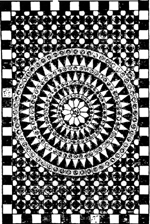
one. A pattern formed by inlaying minor pieces of stone, tile, drinking glass, or enamel into a cement, mortar, or plaster matrix.
ii. A form of surface decoration, similar to marquetry, but normally employing modest pieces or bits of wood to create an inlaid design.
McGraw-Hill Lexicon of Architecture and Construction. Copyright © 2003 by McGraw-Colina Companies, Inc.
mosaic
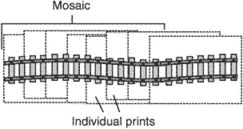
In photogrammetry, an assembly of overlapping aeriform photographs that have been matched to grade a continuous photographic representation of a portion of the world's surface. A mosaic may be controlled, semicontrolled, or uncontrolled. A controlled mosaic is one that is laid to basis control and in which prints are used that take been ratioed and rectified equally shown necessary by the command. A semicontrolled mosaic is composed of corrected or uncorrected prints laid to a mutual footing of orientation other than ground control. An uncontrolled mosaic is composed of uncorrected prints, the details of which have been matched from print to print without basis command or another orientation. Likewise called an aerial mosaic.
An Illustrated Dictionary of Aviation Copyright © 2005 by The McGraw-Colina Companies, Inc. All rights reserved
mosaic
i. a design or decoration fabricated upwards of small pieces of coloured glass, stone, etc.
2. the procedure of making a mosaic
3.Genetics another name for chimera
four. a light-sensitive surface on a television camera tube, consisting of a big number of granules of photoemissive fabric deposited on an insulating medium
Mosaic
, Mosaicalof or relating to Moses or the laws and traditions ascribed to him
Collins Discovery Encyclopedia, 1st edition © HarperCollins Publishers 2005
Mosaic
(World-Wide Web, tool)NCSA'southward browser (client) for the World-Wide Web.
Mosaic has been described as "the killer application of the 1990s" because it was the commencement program to provide a slick multimedia graphical user interface to the Internet's burgeoning wealth of distributed information services (formerly mostly limited to FTP and Gopher) at a time when admission to the Net was expanding rapidly outside its previous domain of academia and big industrial research institutions.
NCSA Mosaic was originally designed and programmed for the 10 Window System by Marc Andreessen and Eric Bina at NCSA. Version 1.0 was released in April 1993, followed by 2 maintenance releases during summer 1993. Version 2.0 was released in December 1993, along with version i.0 releases for both the Apple Macintosh and Microsoft Windows. An Acorn Archimedes port is underway (May 1994).
Marc Andreessen, who created the NCSA Mosaic research prototype every bit an undergraduate pupil at the Academy of Illinois left to start Mosaic Communications Corporation forth with v other erstwhile students and staff of the university who were instrumental in NCSA Mosaic's blueprint and development.
http://ncsa.uiuc.edu/SDG/Software/Mosaic/Docs/help-nearly.html.
ftp://ftp.ncsa.uiuc.edu/.
East-mail: <mosaic-10@ncsa.uiuc.edu> (10 version), <mosaic-mac@ncsa.uiuc.edu> (Macintosh), <mosaic-win@ncsa.uiuc.edu> (Windows version), <mosaic@ncsa.uiuc.edu> (general help).
This commodity is provided by FOLDOC - Costless Online Lexicon of Computing (foldoc.org)
Mosaic
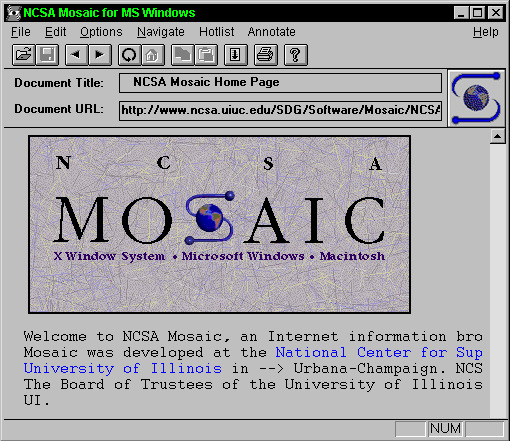
The first multimedia browser for the Spider web, assuasive text, images, sound and video to be accessed via a graphical user interface. Mosaic was created by Marc Andreessen, Eric Bina and others at the Academy of Illinois National Center for Supercomputing Applications (NCSA). The "Killer App" of the Web
Mosaic was released on the Internet in 1993 and became "the" application that caused the Web to explode. Originally adult for Unix, it was ported to Windows and Mac inside a few months. Both Andreessen and Bina later went to piece of work for Mosaic Corporation, which was formed to market place Mosaic, only wound up developing the Netscape browser. The company was renamed Netscape, and the Netscape browser reigned supreme for a while.
The University eventually licensed Mosaic to Spyglass, Inc., which Microsoft acquired. Thus, the Mosaic browser ultimately evolved into Cyberspace Explorer. Run across Web browser and Netscape.
 |
| Mosaic Browser |
|---|
| Looking a bit outdated compared to today'southward browsers, Mosaic was all the same a major goad in revolutionizing the world. It helped the Web to explode, and ultimately, the Internet to become commercial. (Image courtesy of the National Center for Supercomputing Applications (NCSA) and the Lath of Trustees of the University of Illinois.) |
Copyright © 1981-2019 past The Figurer Linguistic communication Visitor Inc. All Rights reserved. THIS DEFINITION IS FOR PERSONAL Use Only. All other reproduction is strictly prohibited without permission from the publisher.
Source: https://encyclopedia2.thefreedictionary.com/mosaics
0 Response to "The Art of Arranging Colored Glass Into Mosaiclike Window Forms Is Called"
ارسال یک نظر